WeSolve educational guide · Video marketing
A customer scrolling past your business on Instagram may give you only a few seconds. Someone comparing service providers on your website may be ready for a fuller explanation. Those situations call for different videos—and different expectations.
Many businesses begin by asking, “Should we make a Reel or an explainer video?” A better starting point is: What does this audience need to understand or do next?
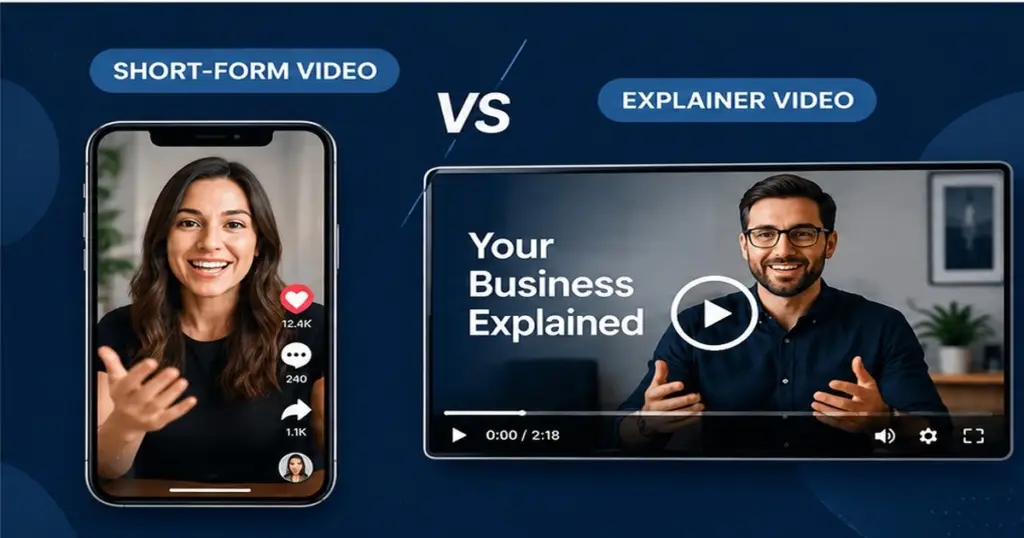
Quick answer: Short-form videos are generally best for communicating one idea quickly and earning attention in a feed. Explainer videos help someone understand a service, product, or process in enough detail to make an informed next decision. Neither format guarantees leads simply by attracting views.
What counts as a short-form business video?
Short-form video is a style of concise, focused content rather than one universal runtime. It commonly appears as Instagram Reels, YouTube Shorts, TikTok videos, and other feed-first formats. People may encounter it before they have searched for your business.
A useful short clip usually has one job: demonstrate a feature, answer a common question, expose a mistake, or explain a problem your customer already recognizes.
For example, a Calgary renovation company could show three details a homeowner should confirm before asking for an estimate. That is educational and specific; it does not require a hard-sell voiceover.
When short-form content is a useful choice
- Introducing your business to audiences who do not yet know you.
- Teaching a single helpful tip or showing a short process.
- Building a repeatable educational series for social channels.
- Directing interested viewers to a complete guide, service page, or inquiry option.
The limitation is context. A brief clip might attract attention without answering every question. Views are not the same as qualified inquiries.
What does an explainer video do?
An explainer walks viewers through what a service is, who it helps, how it works, and what happens next. It can be live action, a screen recording, animation, an on-camera presentation, or a combination.
Imagine a business providing managed IT services. A helpful explainer might show how onboarding works, what is included in employee setup, how support tickets are handled, and which responsibilities remain with the customer. It gives a prospective buyer useful clarity before contacting the company.
When an explainer makes more sense
- Your service is unfamiliar or difficult to describe in a sentence.
- Prospective customers have recurring questions about the process.
- Decision-makers need to compare options or share an explanation internally.
- Your website needs a clearer answer to “What happens after I contact you?”
There is no ideal length for every explainer. Use only the time needed to answer the viewer's question. Chapters, on-screen examples, readable captions, and clean audio are often more valuable than flashy transitions.
Explainer vs. short-form video: the practical comparison
Short-form video
- Primary job: earn attention around one idea.
- Common setting: Reels, Shorts, TikTok, and social feeds.
- Best content: one tip, one demonstration, one question.
- Next action: view a longer resource, visit your profile, or explore a service.
Explainer video
- Primary job: remove uncertainty and explain value.
- Common setting: website, sales follow-up, landing page, or YouTube.
- Best content: a process, service overview, demonstration, or FAQ.
- Next action: inquire, request an estimate, or book a discussion.
Choose the format based on the customer's journey
Discovery: “I didn't know this business existed”
A short clip answering a recognizable customer question can be a sensible place to begin. Evaluate whether it reaches a relevant audience, not just how many times it is played.
Consideration: “How does this actually work?”
An explainer or process walkthrough helps customers compare approaches and understand what they would receive. Pair it with a clear service page that offers additional detail.
Decision: “What happens if I contact you?”
A focused onboarding or consultation-process video can reduce uncertainty. The objective is clarity and confidence—not a longer list of claims.
One business topic can become three useful videos
Consider a hypothetical Calgary bookkeeping business explaining year-end preparation to small-business owners:
- A short vertical tip: “Three records to organize before your bookkeeping review.”
- A full explainer: a walkthrough of document intake, review, questions, and next steps.
- A focused FAQ clip: “What happens after we receive your documents?” for the service page or follow-up email.
The three assets answer different questions while keeping the core explanation consistent. They are illustrative examples, not claims about a WeSolve customer or campaign.
What should you plan before filming?
- Audience: decide who needs the information and what they already understand.
- One clear takeaway: keep each asset focused on an actual question or decision.
- Distribution: plan whether it belongs on your website, Instagram, LinkedIn, YouTube, or in email.
- Format: capture vertical framing for feed-first clips and appropriate layouts for website and presentation contexts.
- Accessibility: include accurate captions and legible on-screen text.
- Permissions: obtain approval for people, testimonials, client footage, and licensed materials.
- Follow-through: decide what viewers should do after watching and how that journey will work.
Good sound, clear examples, and a relevant message can matter more than expensive equipment. A highly produced video that does not explain anything useful may fail its purpose.
How should you measure video marketing?
Set the metric based on the job of the video. A discovery clip may be evaluated on audience relevance, viewing behaviour, and visits to related resources. A service explainer may be evaluated on helpful inquiries and how viewers move through a decision.
- Audience exposure: where was the content shown, and to whom?
- Viewing behaviour: what did people watch, skip, or revisit?
- Meaningful actions: did viewers click through to relevant information?
- Qualified interest: did you receive questions or inquiries that relate to the offer?
For example, YouTube's Shorts analytics documentation describes feed and engagement metrics. Such measures describe viewer behaviour, not verified sales.
Be careful about attributing revenue to a video just because business activity increased around the same time. When possible, use correctly configured links and inquiry-source information, and make limitations clear.
Which format should you produce first?
If people regularly ask what your service includes or how the process works, start with a well-planned explainer. If your audience understands the category but has never heard of you, consider a small series of helpful short-form clips.
If both challenges apply, a practical starting point is one core explainer with a few short edits drawn from the same topic. Test the message, learn from actual audience behaviour, and refine before scaling production.
Distribution matters too. Explore how social media marketing and video content planning can support each other across the channels your customers use.
Need a clearer video strategy for your business?
WeSolve helps businesses plan and produce useful video content, from short-form clips to service explainers. On-site filming is offered in the Calgary area, while video editing and strategy services are available beyond Calgary.
Explore WeSolve Video Marketing →Educational content by WeSolve Digital and Marketing Solutions. The business examples above are hypothetical. Video performance depends on audience, message, placement, measurement, and execution.