
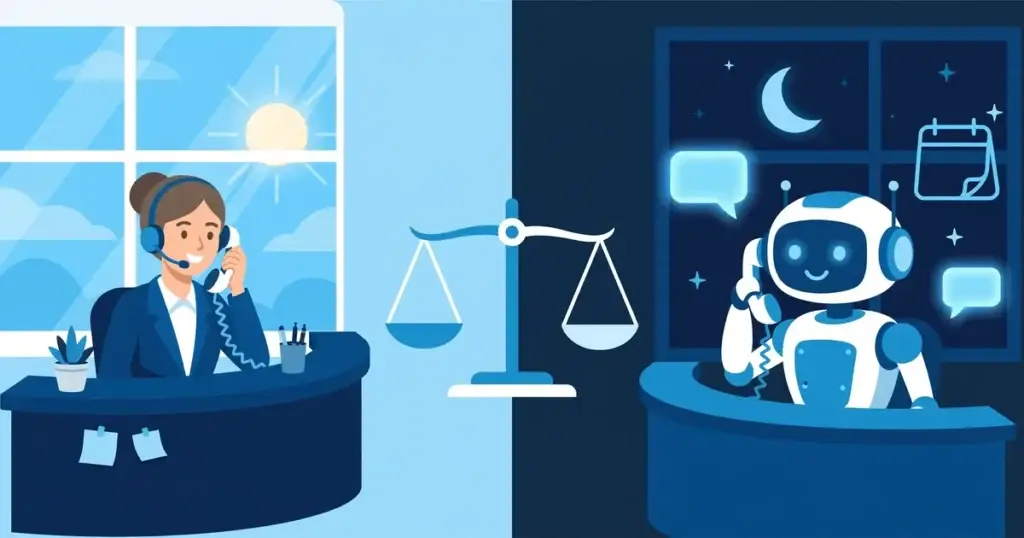
Compare real responsibilities, wage costs, AI subscription models, missed-call risks and the limits of automation. Then estimate what better call coverage might mean for your business.
A caller rings your business at 6:15 p.m. You have closed for the day. That call might be a routine question, an urgent request, or a customer ready to book. Should an AI receptionist answer it, should you hire another employee, or is the right solution somewhere in between?
For Canadian small businesses, the AI receptionist versus human receptionist decision is not simply about replacing a wage with a software subscription. It is about coverage, customer experience, accuracy, escalation, privacy and measurable booking outcomes. The best answer depends on your volume of calls and what happens after someone says hello.
AI receptionist vs human receptionist: at a glance
| Factor | AI receptionist | Human receptionist | Practical takeaway |
|---|---|---|---|
| Availability | Can answer at night and on weekends if configured and service is operational | Limited to staffing shifts unless coverage is arranged | AI is useful for call overflow and after-hours intake |
| Cost structure | Subscription, setup, usage, phone and integration charges may apply | Wages, payroll costs, training and coverage | Compare total cost, not subscription versus salary alone |
| Routine questions | Fast answers from an approved knowledge base | Can explain and clarify based on experience | Either works for familiar requests |
| Complex or upset callers | Needs safe routing and a clear escalation path | Can exercise empathy and discretion | Human assistance remains essential |
| Appointment booking | Can book when connected to a reliable calendar and rules | Can negotiate exceptions and unusual requests | Test your actual workflow before relying on AI |
| Data privacy | Requires vendor, data and recording reviews | Requires staff training and privacy controls | Neither option removes privacy obligations |
What does an AI receptionist actually do?
An AI receptionist is a voice-based system designed to respond to incoming calls, understand supported requests and take pre-approved actions. Depending on its configuration and connected business systems, it may greet callers, answer common questions, capture contact details, identify the reason for the call, offer appointment times, send follow-up messages or transfer a caller to a person.
There is a huge difference between a generic voice bot and an AI receptionist connected to a functioning CRM and calendar. A demo that sounds natural is not the same as a deployed system that correctly handles business hours, duplicate appointments, emergencies, consent and escalation.
After-hours enquiries
Capture the details needed for a timely response when your staff are unavailable.
Routine scheduling
Offer approved appointment slots, confirmations and follow-ups where integrations support them.
Overflow coverage
Take standard calls while human staff focus on complex customers and in-person visitors.
How much does a human receptionist cost in Canada?
The Government of Canada's Job Bank reports a $22.00 CAD median hourly wage for receptionists in Alberta. At 40 hours per week over 52 weeks, that is approximately $45,760 CAD in annual base wages or $3,813 CAD per month, before statutory payroll costs, benefits, training, equipment, hiring or additional shift coverage. This is a wage benchmark, not a guaranteed quote for every Calgary employer. Source: Government of Canada Job Bank.
A receptionist does more than answer calls. Staff may greet visitors, handle paperwork, solve problems, support colleagues and maintain customer relationships. If the role combines front-desk duties with phone calls, an AI voice agent would replace only some of those tasks—not the entire position.
How much does an AI receptionist cost?
AI receptionist pricing is often billed as a monthly platform fee, a per-minute charge, a bundled allowance or some combination. Additional expenses may include phone service, call transfers, speech and language models, integrations, onboarding, knowledge-base updates, security review and managed support. Review exclusions closely.
HighLevel, for example, documents AI Employee subscription options as well as pay-per-use components, and notes that phone system costs may still apply even where some AI voice use is covered. This is provider cost information, not a WeSolve retail quote. See HighLevel's current AI product pricing documentation and pricing guide.
Calculate your missed-call opportunity and estimated costs
This calculator is a planning tool, not a revenue promise. It assumes that some missed calls represent qualified opportunities, some are recoverable through better answering, and only some eventually become paying customers. Enter your own call-tracking and sales data where possible.
Missed-call & receptionist cost estimator
All values in CAD · Illustrative onlyThis calculator is entirely local: values are calculated in your browser and are not submitted to WeSolve. Do not treat assumptions as guaranteed leads, bookings, profits, savings or operational performance. CAD amounts are examples; USD platform quotes require a separate exchange-rate calculation.
Example: What happens when a business misses 50 calls a month?
Suppose a local service business receives 200 calls monthly and misses 25%, or 50 calls. If half of those are qualified enquiries, an appropriately configured AI agent handles 60% of them, 40% book, and half of bookings become customers, the model estimates three additional customers per month. At an illustrative $500 average sale and 40% contribution margin, that would equal $600 in incremental contribution before AI expenses—not $1,500 in pure profit. The result will be lower if calls overlap with people who would have booked anyway.
Use the calculator to replace these illustrative assumptions with actual phone logs, conversion data, customer values and provider invoices. This is especially important for companies with seasonal demand or long sales cycles.
Where a human receptionist is still the better option
Humans are usually the safer choice for distressed customers, complaints requiring judgment, unusual pricing requests, sensitive personal information, nuanced scheduling conflicts and anyone who wants to speak to a person. A trained employee can also observe nonverbal cues and help visitors in person. AI should be designed to recognize its boundaries and transfer calls cleanly rather than guessing.
Where an AI receptionist can be especially useful
Home services and Calgary trades
Plumbers, electricians, HVAC teams and restoration businesses often work away from a desk. After-hours intake can capture the address, urgency and callback details while routing true emergencies according to an approved policy. Never allow a voice agent to claim a technician is on the way without confirming dispatch.
Clinics and appointment-based businesses
An AI assistant may handle basic hours, location and available appointment slots, but it should not offer medical advice or decide the urgency of a health concern. Healthcare privacy and consent requirements demand special attention, and sensitive calls should be escalated.
Real estate and professional services
A receptionist can collect initial property or consultation enquiries, schedule an approved appointment and route specialized questions to a licensed or authorized professional. It must not invent listings, prices or professional advice.
The hybrid model: AI handles coverage, humans handle judgment
A hybrid setup can keep existing staff as the main relationship owners while directing common after-hours questions or overflow calls to an AI agent. For many small businesses, this is a more realistic objective than replacing an employee outright. Review unresolved calls and transfer failures weekly, and keep an easy route to a person.
Privacy, call recording and transparency in Canada
Businesses that collect caller information need appropriate privacy practices. The Office of the Privacy Commissioner of Canada says organizations subject to PIPEDA must comply with its requirements when recording customer calls, whether the business or caller initiated them. The regulator updated its guidance in October 2026, including considerations regarding sensitive voiceprints. Read the Office of the Privacy Commissioner's updated announcement and its guidance on recording customer calls.
Before deployment, identify where recordings and transcripts are stored, the vendor's retention rules, who can access them, whether data can be used for model training, what callers are told, and how someone can request human assistance. Provincial privacy rules and industry obligations may also apply; seek qualified advice for your situation.
Seven questions to ask before you buy
- Does the quote include phone numbers, call minutes, model costs, transfers and support?
- Can the agent reliably book, cancel and reschedule using our real calendar?
- What happens if the AI misunderstands a caller or an integration fails?
- Can we escalate sensitive, angry and urgent calls immediately to a person?
- Who owns the conversation data, and what is the retention policy?
- Is after-hours coverage measured by actual calls answered and bookings completed?
- Can we run a limited pilot and review recordings/transcripts where legally appropriate?
Can an AI receptionist replace a full-time employee?
Sometimes it may eliminate the need for a dedicated after-hours answering position or reduce repetitive call handling. But a full-time receptionist often performs many non-phone duties. Evaluate which tasks can genuinely be automated, which still require people, and whether the actual benefit is faster response time rather than salary reduction.
How WeSolve Digital can help you evaluate AI call handling
Start with a call-flow audit rather than purchasing a tool based only on a demo. Document frequent caller questions, opening hours, your preferred booking process, escalation paths and the systems your team already uses. WeSolve Digital can discuss where AI-assisted workflows and CRM automation may fit your business, without promising a specific ROI before reviewing your real requirements.
For a broader breakdown of token, credit, call-minute and subscription models, see our 2026 AI agent cost comparison. For a look at how content and automation contribute to customer acquisition, read our SEO content writing guide.
Wondering how many calls your business could recover?
Let's review your current inbound call flow, booking process and customer handoff requirements. We'll identify which calls are suitable for automation—and which should always reach a person.
Book an AI automation consultationFrequently asked questions
Is an AI receptionist cheaper than a human receptionist?
It can have lower direct operating costs for supported phone tasks, especially after hours. A valid comparison also includes subscription and usage costs, setup, errors, support and the human tasks AI does not replace.
Can an AI receptionist book appointments?
Yes, if the service connects reliably to your calendar, is given the right rules and is tested for conflicts, changes and cancellations.
Can a customer ask to speak with a human?
They should have a clear, reliable way to do so. Design a fallback process for difficult, urgent or sensitive calls.
Does an AI receptionist work 24/7?
Many services are designed to answer outside normal business hours, but actual availability depends on the vendor, phone systems, integrations and outage arrangements.
What happens if an AI receptionist gives the wrong answer?
Build with an approved knowledge base, restricted actions, call monitoring, escalation and correction procedures. A business remains responsible for its customer experience and applicable obligations.
Is a $200 AI suite enough for my business?
It depends on the currency, included features, calls and minutes, setup, phone charges, CRM integrations and support. A monthly price alone cannot show the total operating cost.
Sources and methodology
This article uses Canada's Job Bank for the Alberta receptionist wage benchmark, official HighLevel documentation for pricing structures and the Office of the Privacy Commissioner of Canada for call-recording guidance. Figures in the calculator and examples are editable assumptions rather than published industry averages. Rates, laws and vendor policies can change; confirm current terms before making financial or compliance decisions.
Editorial review date: November 2026. Prices are CAD unless specifically labelled otherwise. This article provides general business information, not legal, employment or financial advice.